Sunday, February 1, 2009
Congratulating the 'Daddy' of all Republicans
When I think of satire, I usually think of "The Daily Show" or "The Colbert Report", and only recently have I begun to think of Mark Twain in that sense too. Satire seems to often be a smaller or less influential figure attacking a larger idea, such as Mark Twain satirizing all of the south. So it me by surprise when I came upon a somewhat influential person taking on another of about equal status. I dont know why, but i found it very amusing to read, even though it doesnt seem to be written with the purpose of highly entertaining the reader. Here, in "A History Lesson for Rush Limbaugh", CNN's James Carvil attack's Limbaugh with heavy sarcasm a dash of juxtaposition and a bit of exaggeration. It would have been easy for me to read over this just a few months ago and maybe only just pick up on a bit of sarcasm, but while reading the article I felt like i was reading what Carvil meant instead of just reading what he wrote. And I have to thank Twain and AmStud for my sharpened satire senses. Now with my super satire senses, I can read beneath the seemingly innocent words and into the sarcasm and mockery which lies beneath.

Sunday, December 14, 2008
The Ultimate Way to Simplify Your Life
Have you ever wanted to simplify your life? and I mean beyond doing away with meaningless stresses, but also eliminating cell phones, computers, fights, clothes, gossip, etc etc. If you are really committed to making your life as simple as possible, you may want to consider following the footsteps of A.J. Jacobson, who lived according to every Biblical rule for one year as a Journalist in Manhattan. He wrote about his year in his book 'The Year of Living Biblically'. To get an idea of what he experienced, here are some of his 700 rules. From 'no gossip' to 'giving thanks', from 'No clothes made of two kind of stuff' to 'do not trim the sides of your beard', Jacobs attempted to follow every rule he could find in the Bible. Because the Bible is such an ancient text, it goes without saying that following it exactly will be no easy task, but if ancient times were so much simpler, wont following it make our life easier? and if so, if Thoreau wanted to simplify his life, why didnt he just resort to the Bible's rules? According to his website (I did not read the book), Jacob's year had several effects. In some ways it made him appreciate life more and to give thanks to things we all take for granted. But in other ways, it presented him with a new kind of stress of following God's law. Simple things such as finding a seat or buying clothes became stressful chores. So in some ways, life was simpler under the Bible, but in other ways it stressed his life to a new level. If someone had attempted this in Thoreau's time, however, the stress may have been a little toned down compared to today. Most clothes were one material, and certainly there would have been less peer pressure about shaving your beard. I would like to have seen Thoreau attempt this feat of such strict living, but from the sounds of it, it seems as if he achieved the same while living in the woods as Jacobs did after living a year Biblically. I get the impression from the authors' conclusions that they both appreciated the little things in life more and had a new sense of gratitude for a simple life. Perhaps living in solitude in the woods brought Thoreau as close to the Diving Spirit as Living Biblically brought Jacob's to God.
Tuesday, December 2, 2008
The Race for Stuff
While watching the clip from 'Far and Away' when the settlers are running and fighting for plots of land, I was reminded of the Wal-Mart employee in New York that was trampled to death among shoppers racing through the doors to get to sale items. The shoppers broke the doors off their hinges in the early morning hours of Friday to get inside the store to begin their blitz for on sale items. Everything from the race to claim property to the disorganization and the onslaught of people is the same. The only difference that stood out for me was the glorifying music playing in the background of 'far and away' as opposed to the chaos of the Wal-mart videos. But 'Far and Away' was a movie meant to glorify the 'American Destiny', and it is very likely that the actual land rush was very similar to the Wal-mart on Friday. The reason these two events so far apart in time are so similar may be that property and land have become something necessary to acquire in order to achieve happiness or success. In the 1800s land and the frontier was associated with a new start to life and, as shown in the Oklahoma land rush and 'Far and Away', everyone was competing and racing for their own plot of land. This race for stuff was repeated last Friday, demonstrating that the idea of moving west has translated into getting the latest and greatest thing. Even if it means trampling and killing a man to get to a set of shoes on sale.
Sunday, November 23, 2008
Progress to Some, a Hurdle for Others
While on surfing the Internet community on Facebook, I got a little sidetracked and came upon a link titled something along the lines of 'anti-pro-ana' to a group that attempted to spread the word about eating disorder groups. I searched for news stories and found one on newsweek that detailed about how these and groups of the other side are actually very numerous. Many have touted Facebook and other social networking sites as places where people can find others with similar interests as them, as well as keep in touch and keep up with friends. And with the sites growing at incredibly fast rates, there are more chances for people to find similar interest groups. Its usually said that this growing community of people and shared idea is a good thing. But, as we usually do in American Studies, we should put a question mark after saying that this is progress, and my discovery on Facebook today prompted that. With the Facebook population growing, people have created support groups for people with eating disorders. This isnt a support group to help teens get out of their disorder, but one that encourages girls to go on extreme diets to lose extreme amounts of weight. some even have places where members can post pictures of themselves and other users can comment on "problem areas". Like one former member said "I was encouraged to stop eating when I saw how many people were doing it". While the progress in many areas because of these sites is undeniable, there are other topics where these websites have caused damage, this being one of them. But to go even further and put a question on our question mark, there are some good sides to the groups that can be called progress. Marcia Herrin, a Dartmouth professor, is glad to see that teens are comfortable talking about eating disorders and arent as afraid to share and admit that they have a disorder. So while these networking sites are a progress in social communities and the spreading of ideas there always must be a question mark, because things dont always seem as they are. Then again though, you should look for yet another question mark; one that reveals a silver lining to a situation. When it comes to these groups, people have to decide if the progress the group presents is greater than the harm it causes, because every situation of progress has a question mark and a drawback.
By the way, I checked for the group again today but it turns out facebook deletes the groups when the find them because they violate the terms of agreement by "promoting self harm or Harm to others".
Sunday, November 16, 2008
Undeniable Progress
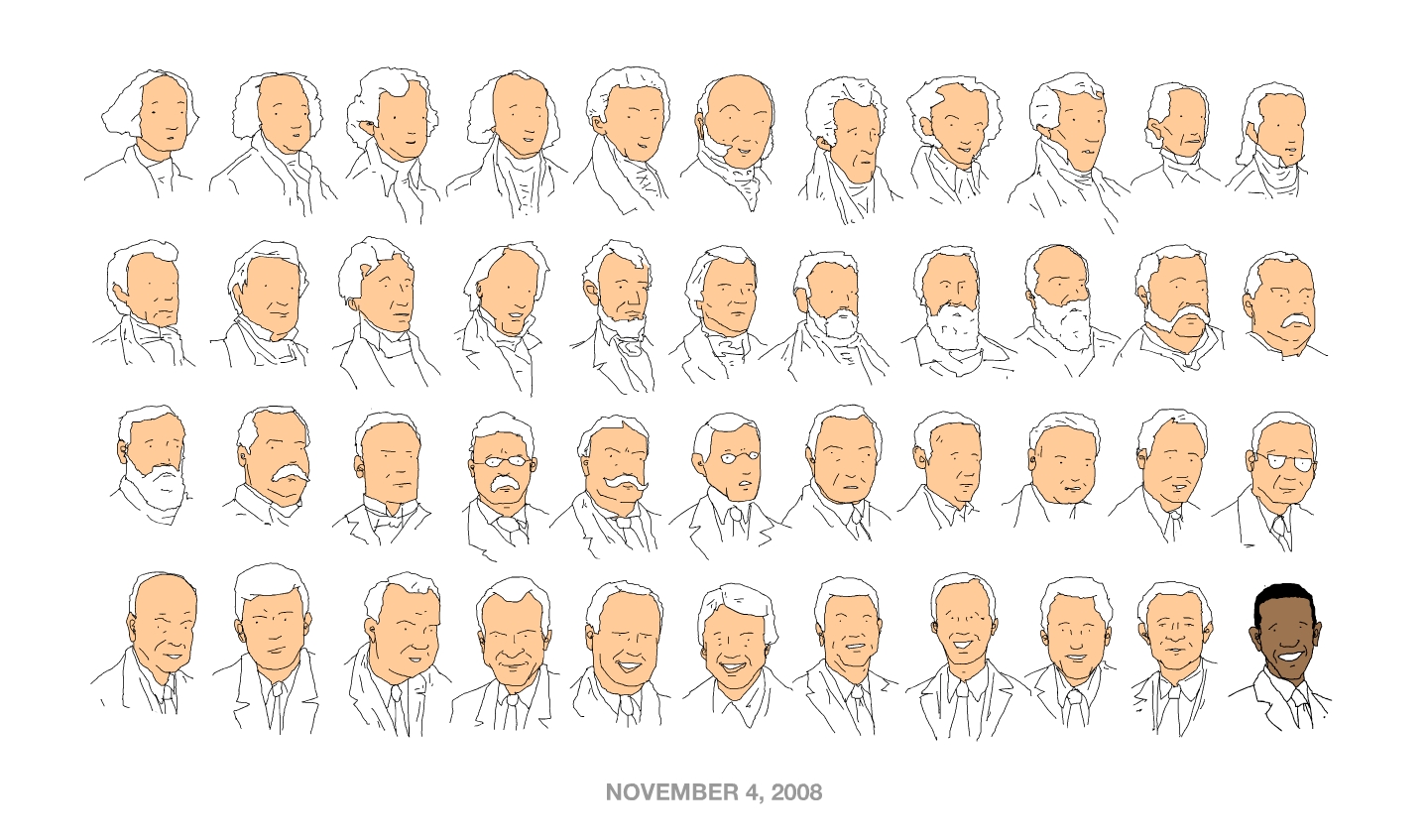
It would be very difficult for a person to claim we are not progressing as a nation after such an historic election. This cartoon shows just how monumental the election of Barack Obama really is. For forty three presidents and over 200 years, the appearance of the man in charge of this nation has not changed much at all; all white males, maybe a little older, and with some white hairs. But now that image has undeniably changed dramatically. The election of an African American to the highest office in the land was unthinkable even 30 years ago. That has all changed now, and Americans have proven that we can see past a person's skin color. But to add a question mark to progress in this sense, is it really as monumental of progress as people say? sure it is, but President-elect Obama is one man and just one case in the fight against racism. Racism will still exist in America for a long time. So although the election is definitely a monumental step in American politics and social life, it cannot be said that this Progress has lifted America above racism, although it is a huge step towards it.
Monday, November 10, 2008
A Slap to the idea of an Idealist Future
In Election Expectations, Wray Herbert takes to a pragmatic way of journalism that has been such a rarity this election season that attempts to lower the bar of expectations of our new president elect. For the past year or so, journalists and media have been preaching of a new, idealistic future, whoever the winner may be. Now that this grueling election has concluded with a sudden and for some unexpected one day finale, people have started to look towards the future. Many Americans feel optimistic about the future and have not put the possibility of an idealistic future out of the picture, nor have they considered the possibility of just an average next four years. Herbert attempts to explain why people do not plan for future disappointment in a series of fancy and sometimes unclear scientific facts. One could even go so far as to say Herbert is being a pessimistic fool. But what he is really trying to do is lay some cushions down so that if people are disappointed, they will land with a little less pain. Through Scientific terms and explanations, Herbert attempts to prove that humans are bound to be unprepared for disappointment and failure. In many ways he succeeds, but I think his main reason for writing the article is to just put a warning out there for the thousands of new idealistic Americans. I applaud his efforts to plan for failure, because without people like him we would fall hard and struggle to get back up on our feet after our idealistic goals fail.
Sunday, November 2, 2008
"Ua mau ke ea o ka 'aina i ka pono" - Revising an Island's Constitution
Should Hawaii Re-write it's constitution? Again?
As election day approaches, few people are focused on what else is on the ballot besides the two major presidential nominees. In three states (Illinois, Connecticut, and Hawaii) there is a box to vote for a Constitutional Convention. The conventions, if they are held, may go unnoticed in Illinois and Connecticut, but Hawaii is a different story. As we have talked in class about how state constitution's play a larger role in daily life than the US constitution I began to try and think of examples of when the Illinois constitution made my life different than someone living in Wisconsin or Indiana. I failed to think of an example and my notion that the Illinois Constitution made little difference in my life continued. Overall, the 48state's Constitutions do not vary greatly from each other and seem to be trivial things that are left to be argued about in Springfield or some place of equal importance. When I read an article detailing the effects of Hawaii's constitution, I was surprised to learn that hawaians may see the effects of their constitution on their live's daily. Hawaii has changed its constitution twice since statehood, and thats a lot considering it is a young 49 years old. Each of these revisions have had far reaching effects on the island chain's small population (just above 1 million). The last convention, or ConCon as the locals call it, added 1,000 changes, and included the hawaiian saying in this title in the preamble, for example. The changes also made Hawaiian an official language, granted natives equality, and dramatically changed Hawaiian society "many of the changes to the constitution crystalized the renaissance in Hawaiian culture that included the resurgence of hula dancing, navigating ocean canoes, and brought back the traditional Hawaiian culture" With the uniqueness of the constitution, comes the noticeable actions of state government. Perhaps because the state has such a unique culture, or that it is free of state borders is their constitution and local government such a big deal for Hawaiians. Whatever the reason, I consider Hawaiian locals lucky to be able to notice the efforts, successes, and even failures of their state government in daily life. Maybe if I lived in Hawaii I would give a little thought about what goes on behind closed doors in Honolulu. Hawaii could be viewed in a way as an example of how things would have turned out if the Articles of Confederation actually worked and persisted to this day. So this Tuesday Hawaiians will vote on something that may affect their lives as equally as the new president. As for me, I will go on living my life paying close attention to the federal government and who will be our next president and meanwhile giving little thought to what goes on in a little city called Springfield.
Subscribe to:
Posts (Atom)