Sunday, May 17, 2009
What is Being 'American'?
As we discussed American Identity in class this week, we have focused on identity in the past. And rightly so, since race relations are a center-point of American history. But what caught my eye, and kept me interested, was about the future of American identity. The article was on CNN, and unfortunately failed to go farther than simple facts and light speculation. The article, titled 'Hispanic population boom fuels rising U.S. diversity', explains that a booming minority population, mainly hispanic, is saving the U.S. economy by providing high demand for consumer goods. This is all fine and dandy, (if you want specific numbers, read the article) but what really got me thinking was the question, "If in the future, there is no single majority, what will become of the typical idea of the 'American Identity'?" We have talked about people striving to assimilate and 'become' American to fit in, but if there is no majority population to be like, will people still attempt to rid themselves of 'foreigness' to fit in? Perhaps people may not feel like they need to fit in because they already fit with their own minority, and there will be a different American dream for Asians, Hispanics, African-Americans, Caucasians, etc. Or maybe each group will mesh, to create a sort of new American idea that immigrants and minorities will strive to become. Whichever it is, only time will tell what booming minority populations will do to American culture.

Monday, May 11, 2009
Dont Forget About Iran

After we did the Iranian crisis simulation, I had a new appreciation and understanding for the gravity and seriousness of the situation us, and the world, are in with unstable relations with Iran. But more than once when thinking back on it, I found myself thinking in past tense "what if Iran had..." or "were lucky they didnt...". I think the reason for this is because Iran seems to be just a side note in todays news, something that was huge a few years ago but today has fallen by the wayside, maybe because we have all gotten used to the threat. As an example, most of the crisis articles we read were written in 2006, and articles on Iranian nukes today are somewhat of a rarity. There was a recent surge in articles related to Iran, but that was because of the 2009 campaign and a journalist who had just been released from prison there. It seems like we have placed Iran in the category "yea its there, we'll deal with it later". But it is important to continue to keep Iran on the front of our international topics, since a search of the words 'Iran' and 'nuclear' on CNN yield a few alarming articles which for some reason never gained headline priority. One article details a report which claims the Iran may have enough material for a nuclear weapon in a matter of months. Even more worrying, it also goes on to explain that Israel may have been planning a strike on Iran only a few months ago but backed out because the US would not support them. This undoubtedly means tensions are still high and a possibility of confrontation is still very likely, so why have people stopped talking about it outside of American Studies simulations? My blunt answer is that we have become bored with it. The media is simply a business, and they cater to what we want. After a few months of high tensions regarding Iran, people realize there are more pressing matters for them and move on. The same has happened with North Koreas Nuclear program many times. Kim Jong Il detonates a bomb or something, and he gets center stage for international media, and thus gains attention in relations between countries. After a few months, however, interest in North Korea dies down and Mr. Il finds another way to capture our attention. The same situation can be seen happening in Iran, except they are not trying to gain our attention by flaunting their technology because unlike North Korea, Iran is not in dire economic need or on the brink. So being left alone to play with nuclear material is perfectly fine for them. But not for us. Unlike many other topics we have studied, the Iranian crisis is very current, and is still a major issue. Just because we have finished our Unit and Iran isnt blowing stuff up, we should still pay attention to it because it has the potential to turn into World War III, as our simulation lightly displayed.
Sunday, May 3, 2009
How to show a war story
This week while cruising the interwebs, I came across a media section on the New York Times. A certain link titled An Ambush and Comrade Lost caught my eye which turned out to be a slideshow of pictures taken before, during, and after an ambush in Afghanistan. The story is remarkably similar to the one O'Brien tellls of the booby trap. The first time I watched it was at school, so there was no sound, but upon watching it at home, I was surprised to find that accompanying the pictures was the story being told by a soldier who was there through a sound clip which matched up with the pictures. This simple addition dramatically altered the feeling I got while watching again. The voice gave the story a background, meaning, and emotion. Pictures alone lacked a certain something which made the story feel real and tangible. Hearing the story through the voice of a soldier who was there made you feel some of the same emotions he felt during and after the attack, which brings me to my question. When depicting a war story such as O'Brien's or this slideshow, is it better to tell the story through pictures or words. Everyone knows the saying a picture is worth 1000 words, but those words may lose their meaning and effect when the reader is left to interoperate the images and story for themselves. With a primary source spoken story, tone and emotion paints an image in the mind which goes deeper than simple photographs can. Pictures also somehow lose the meaning a story may hold. Like O'Brien says, war stories can be true stories that never happened. When a story is based off of pictures, you know it happened, and there is little room for details to be varied. I may be wrong, but when it comes to a war story, I think the right way for a soldier to tell theirs through the most original form of storytelling.
Sunday, April 26, 2009
Civilian Bombing or Tactical Airstrikes?
While watching "People's Century" on Friday about civilian bombing, it was clear where the line was between military and civilian bombing (at least as clear as it can get). Bombing by both sides during WWII included heavy focus on non-military targets, heavily populated cities with no significant military value, to 'break the will to continue'. Here the line between the two was distinguishable, but since then it has become more and more unclear where military battles end and civilian bombing begins. In Vietnam forests were burned to the ground to chase out the enemy, in Korea the situation was very similar. And in Afghanistan NATO forces carry out 'strategic' air-strikes meant to pinpoint and destroy the enemy. But when the enemy is barely distinguishable and living amongst innocent people, is it civilian bombing? How does a military deal with an enemy who lives and blends in with civilians to deter attack? While it is true that NATO uses the most advanced weapons to make the most of each strike by killing the most amount of enemy, least amount of civilians, using the least amount of explosive, these strikes hardly leave the innocent untouched. We occasionally hear of air strikes missing a target and killing innocent Afghans, but what of the rest, the supposedly 'unharmed'? Dropping 20,000 lbs of explosive will undoubtedly effect anyone living within a mile of the blast. The innocent population lives in fear and stress of the possibility of being bombed at any time, and ruled by insurgents. But if NATO troops were sent in, the situation could turn into a nightmare of not knowing enemy from civilian and going on a goose chase facing a higher death toll than bombing. So the question is, when does tactical bombing become civilian bombing if only insurgents are targeted?
Monday, April 13, 2009
The Original is Always Better

After reading Zoo Story and getting past the initial creepiness I felt, I decided I really liked the short play and wanted to find out more about this Edward Albee whom I had heard so little about before now. So after a quick search on Google and found a plethora of results. Many of them were about Zoo Story and a recent addition by Albee of a second act. The article I ended up in described the new act as a prequel, which opens before the scene we all know and takes place in Peter's house with his "pleasant looking, unexceptional" wife. This prequel is supposed to shed light on Peter's life, but I say, do we really need to know more about Peter's life? He was created to be a pretty unexceptional, middle-class guy whose story we are all familiar with. Even his name, Peter, was made to make him out to be an average guy. Jerry is supposed to be the one whose life is interesting and full of substance, a life too many people like Peter who live in their own bubbles fail to understand. So exploring Peter's life further seems frankly to be a waste of time since we already have a pretty clear understanding and perception of his life, just as Jerry does. In fact, I think it detracts from the value of Peter as a generic middle-class character. By creating him as such a common American ideal life, Albee made Peter into someone that could easily represent many of us or someone we all know. But when his life is explored, you lose some of that generic, mediocre feeling that Jerry indirectly accuses him of being. I think Zoo story is better off without this prequel, and glad that we read the original, the 'good one'.
Sunday, April 5, 2009
The Heart of America
After this unit on affluence and poverty, and especially after the artifact 'Roger and Me', it has become apparent to me just how important cars are to Americans. The unit has almost been about the automobile the same as it has been about privilege and affluence. Few, if any, Americans since the beginning of the 20th century have lived their lives without being substantially effected by a car. It is even said that an American remembers two things for their whole life; their first love, and their first car. In many people's cases it is sure to be the same thing. The Roaring twenties were fueled by the industry of the automobile, many people's last hope lay in their car during the depression, and even in 'The Great Gatsby' the automobile played a large role. So what happens when such an important part of America fails? Unsurprisingly, you dont need to look any farther than today's news. GM and Ford crowd the headlines paired with extremely large sums of money, if the American car company were to fail, what would we do with ourselves? 'Roger and Me' documents that case of 'what if', if only on a small scale. But multiply that nationwide, and you have a very very serious problem on our hands. Michigan, the nearly former car center of the world, is one of the hardest hit areas of the country, with a 12% unemployment rate. And the scenes of 'Roger and me' and even 'semi-pro' from the streets of flint have spread throughout Michigan. So when it comes to the question of "what are we supposed to do with these failing former goliaths?" We can use Flint, Detriot, and the rest of Michigan as an example of what America can become if we let such important aspects of Americana fail. So the Automobile may not be the heart of the American economy, but it for sure is one of the critical organs, maybe the liver, or the stomach, or muscles. And AIG can unfortunately be the heart.
Monday, March 9, 2009
Where New Money is Becoming Old

Although the article I got inspiration for this post from isnt really written about specifically old and new money, but it does have a few similarities to The Great Gatsby. 'You Can't Go Home Again' is about the weakening of the conservative and republican stronghold, Orange County. Johnathan Durnham describes a typical scene in the O.C. where high school girls carry lattes and credit cards, and high end restaurants filled with high end people. This famous western county was born during the post-WWII boom of government funded defense projects and then the prosperity of California's hollywood and computer booms. Since then the O.C. has been considered new money, but how long can new money last? Eventually it is no longer 'new', and becomes part of the ranks of 'Old' Money. The O.C. is changing with new immigrants from the all around, attracted to such a famous social society. But inevitably the social class will change as well, and either whether the scene changes to 'old' money or loses its affluent will depend on how things play out. But it got me to thinking about if the society depicted in The Great Gatsby still remains, if it ever did, on 'East and West Egg' and how the money and society came to be in the first place.
Sunday, March 1, 2009
A Shift in the Job Market
With today's economic situation, every aspect of the economy is changing, including the face of a typical worker. The face of a typical American worker has never remained constant for very long, in the beginning there were farmers who's main difference was what they grew. Then emerged small business and craftsmen such as newspaper's, some of these small businesses dramatically transformed into huge corporations which ushered in the era of assembly lines and sweatshops. One could argue that this was when the worker transformed from a unique individual who took pride in each of his works into simply a number on the assembly line who's only purpose was to tighten that one bolt or cut that one piece of metal. This was the time when a businessman's goal turned from quality to quantity, and not just about the end product. Individual workers were turned into a simple huge number. It's easy to get that feeling these days with all these huge numbers being thrown around, you lose some of the effect after hearing over and over again "GM to cut 30,000 jobs" or "Stimulus package worth $1 trillion". Workers are bundled together so much that they have been turned into a labor force, as if they were one thing thrown around, like the cattle or pigs of the stockyards. No one takes notice when they hear "we slaughter 50,000 pigs" but the most hardened men cringe when they hear the scream of one single pig being slaughtered. I found the similarity while reading a local article about a family diner going out of business and 5 people losing their jobs and having to sell their house with their future in jeopardy. Those 5 people losing their jobs and well being is a tragedy, "GM cuts 30,000 jobs" is only a statistic. Im not very sure why we react so differently, but it might be linked to the time period we are studying in AS, proving that the dehumanization of the masses of factory workers still lingers in little places to this day.
Monday, February 23, 2009
Worse than the Great Depression?
I just came accross this article by Jack Cafferty bringing up and explaining a quote by a leading financial investor, George Soros. Soros claims that the financial crisis we are in is worse than even the Great Depression. Soros said that "The economy went into freefall and is still falling and we dont know where the bottom will be until we get there and there's no sign that we are anywhere near a bottom". He also says that our problems originate in the 1980's with deregulation, and that now is the begining of the end of the free market. As we start our unit exploring financial situations, it should be remembered that each system of an economy has its risks, and that each one controls the ordinary John and Sally. No form of economy is safe from risks, the largest example of Communism failed in the early 90's, and now we, the free market, are in a crisis. Thats not to say that we will plunge into chaos and anarchy, as is mentioned in the article, we have much more safe nets and are no where near the statistics of 25% unemployment of the Great Depression. But no one knows how our example of the free market could turn out after this crisis, it could turn into something we barely even notice. The fact is that there is no perfect form of economy where everyone lives in harmony and peace, People can only try.
Monday, February 16, 2009
The Ultimate Exaggerated Holiday
Recently, that holiday we all love or hate just came and went. Obviously, I am talking about Valentine's Day, the so-called 'Hallmark Holiday'. I think it is fair to call it that, since around this time of year we are bombarded with commercials to buy our loved ones this or that. And I have little problem with commercials for cards, flowers, chocolate, or even jewelry, because this kind of stuff is what people are looking for on Valentine's day. You cant really get angry at marketers for advertising things for a holiday which are in demand, but I think the reason many people hate the holiday is because of those other guys that try and adjust their random product to fit into the theme of hearts and roses and proceed to attempt to sell it with a special "one time offer" Valentine's Day theme. Valentine's day was a prime chance for marketers to sell and exaggerate their products. I really saw an Officemax commercial based for Valentine's Day products. It might just be me who thinks it, but whoever resorts to buying paper and staples for their significant other for Valentine's Day ought to get their priorities straight. In today's world, marketers try and find every reason to convince people to buy their stuff, and it doesnt even matter if their product has no relation to the event to begin with; as long as you can market it to the widest range of people and make it look so much more appealing than it really is. Holidays like Valentine's day are so often used to sell products which are over incredibly over romanticized that we forget the true meaning of February the 14th, which is that other meaning of romanticism, (and of course to buy roses and Hallmark cards). Anything further than that is just ridiculous.
Sunday, February 8, 2009
Romanticizing a Blanket
So I know this is two days late, but I thought it was by sunday, not Friday. But anyways, something I find very over-romanticized and laugh at every time I see on TV is infomercials, but my favorite overly dramatic infomercial would have to be Snuggies. The commercial can be found here. Sure we all love a good blanket in front of a fireplace, and who doesnt like being warm when its cold, but the snuggie commercials go a bit far. Is it really that difficult to pick up a phone, read a book, or do simple tasks in a normal blanket? I for one have ever experienced blanket-induced disabilities, and when Im cold at a sporting event, I wear a coat. I usually dont mind a good infomercial, they give a little unintended comic relief, but Snuggies may go a bit far in romanticizing their product. The commercials make Snuggies seem like a necessity, without which you could never be comfortable. And then they even go farther and portray the snuggie as a sociably normal thing. I for one, and I dont know anyone else who would, would never wear basically a bathrobe around town. So although a Snuggie might be warm and nice around the home, it cant be very different from a normal blanket, and the benefits of simply a backwards bathrobe are incredibly over-romanticized and exaggerated. It may not be very practical, but it does work well as just a comedic relief among a million boring commercials
Sunday, February 1, 2009
Congratulating the 'Daddy' of all Republicans
When I think of satire, I usually think of "The Daily Show" or "The Colbert Report", and only recently have I begun to think of Mark Twain in that sense too. Satire seems to often be a smaller or less influential figure attacking a larger idea, such as Mark Twain satirizing all of the south. So it me by surprise when I came upon a somewhat influential person taking on another of about equal status. I dont know why, but i found it very amusing to read, even though it doesnt seem to be written with the purpose of highly entertaining the reader. Here, in "A History Lesson for Rush Limbaugh", CNN's James Carvil attack's Limbaugh with heavy sarcasm a dash of juxtaposition and a bit of exaggeration. It would have been easy for me to read over this just a few months ago and maybe only just pick up on a bit of sarcasm, but while reading the article I felt like i was reading what Carvil meant instead of just reading what he wrote. And I have to thank Twain and AmStud for my sharpened satire senses. Now with my super satire senses, I can read beneath the seemingly innocent words and into the sarcasm and mockery which lies beneath.
Sunday, December 14, 2008
The Ultimate Way to Simplify Your Life
Have you ever wanted to simplify your life? and I mean beyond doing away with meaningless stresses, but also eliminating cell phones, computers, fights, clothes, gossip, etc etc. If you are really committed to making your life as simple as possible, you may want to consider following the footsteps of A.J. Jacobson, who lived according to every Biblical rule for one year as a Journalist in Manhattan. He wrote about his year in his book 'The Year of Living Biblically'. To get an idea of what he experienced, here are some of his 700 rules. From 'no gossip' to 'giving thanks', from 'No clothes made of two kind of stuff' to 'do not trim the sides of your beard', Jacobs attempted to follow every rule he could find in the Bible. Because the Bible is such an ancient text, it goes without saying that following it exactly will be no easy task, but if ancient times were so much simpler, wont following it make our life easier? and if so, if Thoreau wanted to simplify his life, why didnt he just resort to the Bible's rules? According to his website (I did not read the book), Jacob's year had several effects. In some ways it made him appreciate life more and to give thanks to things we all take for granted. But in other ways, it presented him with a new kind of stress of following God's law. Simple things such as finding a seat or buying clothes became stressful chores. So in some ways, life was simpler under the Bible, but in other ways it stressed his life to a new level. If someone had attempted this in Thoreau's time, however, the stress may have been a little toned down compared to today. Most clothes were one material, and certainly there would have been less peer pressure about shaving your beard. I would like to have seen Thoreau attempt this feat of such strict living, but from the sounds of it, it seems as if he achieved the same while living in the woods as Jacobs did after living a year Biblically. I get the impression from the authors' conclusions that they both appreciated the little things in life more and had a new sense of gratitude for a simple life. Perhaps living in solitude in the woods brought Thoreau as close to the Diving Spirit as Living Biblically brought Jacob's to God.
Tuesday, December 2, 2008
The Race for Stuff
While watching the clip from 'Far and Away' when the settlers are running and fighting for plots of land, I was reminded of the Wal-Mart employee in New York that was trampled to death among shoppers racing through the doors to get to sale items. The shoppers broke the doors off their hinges in the early morning hours of Friday to get inside the store to begin their blitz for on sale items. Everything from the race to claim property to the disorganization and the onslaught of people is the same. The only difference that stood out for me was the glorifying music playing in the background of 'far and away' as opposed to the chaos of the Wal-mart videos. But 'Far and Away' was a movie meant to glorify the 'American Destiny', and it is very likely that the actual land rush was very similar to the Wal-mart on Friday. The reason these two events so far apart in time are so similar may be that property and land have become something necessary to acquire in order to achieve happiness or success. In the 1800s land and the frontier was associated with a new start to life and, as shown in the Oklahoma land rush and 'Far and Away', everyone was competing and racing for their own plot of land. This race for stuff was repeated last Friday, demonstrating that the idea of moving west has translated into getting the latest and greatest thing. Even if it means trampling and killing a man to get to a set of shoes on sale.
Sunday, November 23, 2008
Progress to Some, a Hurdle for Others
While on surfing the Internet community on Facebook, I got a little sidetracked and came upon a link titled something along the lines of 'anti-pro-ana' to a group that attempted to spread the word about eating disorder groups. I searched for news stories and found one on newsweek that detailed about how these and groups of the other side are actually very numerous. Many have touted Facebook and other social networking sites as places where people can find others with similar interests as them, as well as keep in touch and keep up with friends. And with the sites growing at incredibly fast rates, there are more chances for people to find similar interest groups. Its usually said that this growing community of people and shared idea is a good thing. But, as we usually do in American Studies, we should put a question mark after saying that this is progress, and my discovery on Facebook today prompted that. With the Facebook population growing, people have created support groups for people with eating disorders. This isnt a support group to help teens get out of their disorder, but one that encourages girls to go on extreme diets to lose extreme amounts of weight. some even have places where members can post pictures of themselves and other users can comment on "problem areas". Like one former member said "I was encouraged to stop eating when I saw how many people were doing it". While the progress in many areas because of these sites is undeniable, there are other topics where these websites have caused damage, this being one of them. But to go even further and put a question on our question mark, there are some good sides to the groups that can be called progress. Marcia Herrin, a Dartmouth professor, is glad to see that teens are comfortable talking about eating disorders and arent as afraid to share and admit that they have a disorder. So while these networking sites are a progress in social communities and the spreading of ideas there always must be a question mark, because things dont always seem as they are. Then again though, you should look for yet another question mark; one that reveals a silver lining to a situation. When it comes to these groups, people have to decide if the progress the group presents is greater than the harm it causes, because every situation of progress has a question mark and a drawback.
By the way, I checked for the group again today but it turns out facebook deletes the groups when the find them because they violate the terms of agreement by "promoting self harm or Harm to others".
Sunday, November 16, 2008
Undeniable Progress
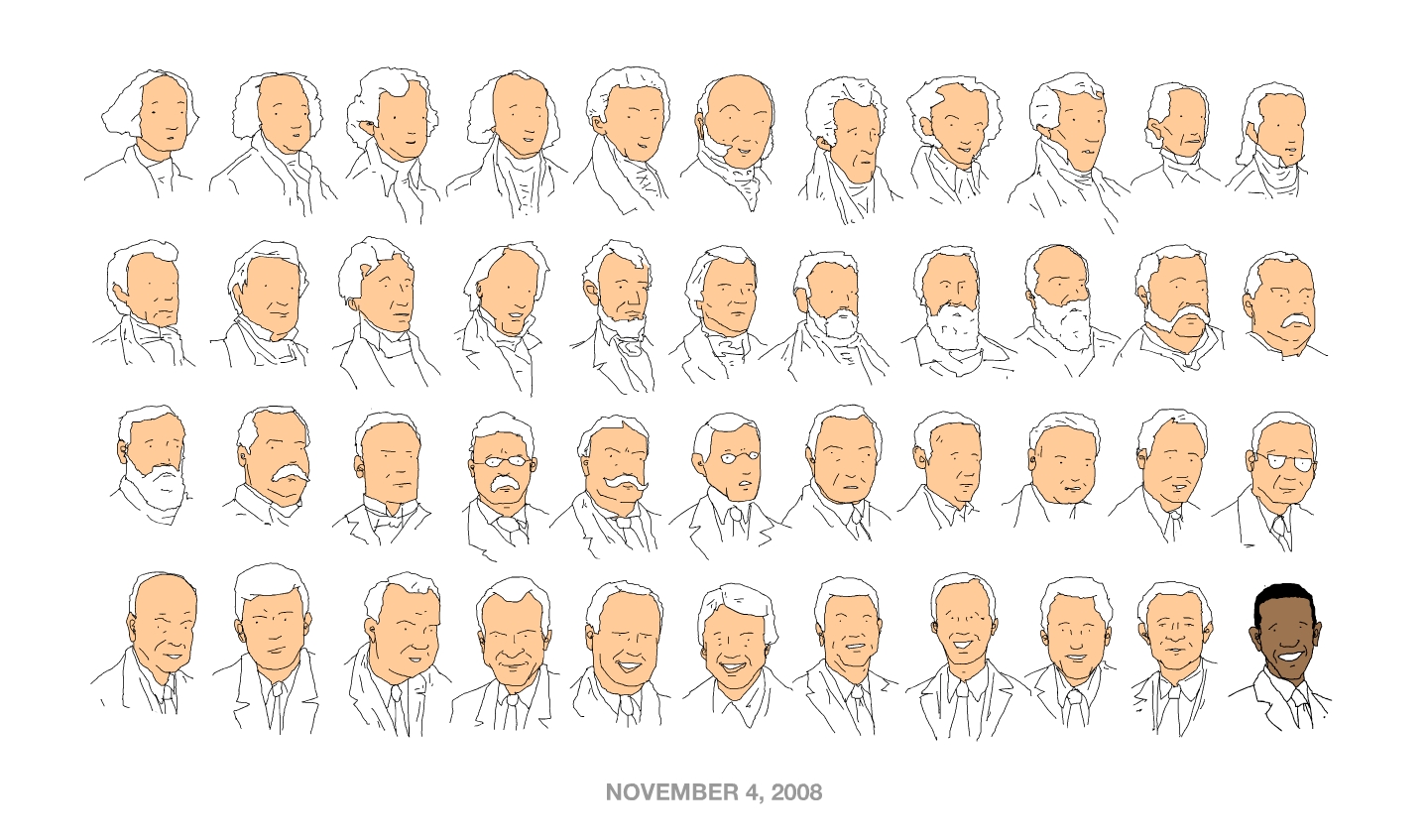
It would be very difficult for a person to claim we are not progressing as a nation after such an historic election. This cartoon shows just how monumental the election of Barack Obama really is. For forty three presidents and over 200 years, the appearance of the man in charge of this nation has not changed much at all; all white males, maybe a little older, and with some white hairs. But now that image has undeniably changed dramatically. The election of an African American to the highest office in the land was unthinkable even 30 years ago. That has all changed now, and Americans have proven that we can see past a person's skin color. But to add a question mark to progress in this sense, is it really as monumental of progress as people say? sure it is, but President-elect Obama is one man and just one case in the fight against racism. Racism will still exist in America for a long time. So although the election is definitely a monumental step in American politics and social life, it cannot be said that this Progress has lifted America above racism, although it is a huge step towards it.
Monday, November 10, 2008
A Slap to the idea of an Idealist Future
In Election Expectations, Wray Herbert takes to a pragmatic way of journalism that has been such a rarity this election season that attempts to lower the bar of expectations of our new president elect. For the past year or so, journalists and media have been preaching of a new, idealistic future, whoever the winner may be. Now that this grueling election has concluded with a sudden and for some unexpected one day finale, people have started to look towards the future. Many Americans feel optimistic about the future and have not put the possibility of an idealistic future out of the picture, nor have they considered the possibility of just an average next four years. Herbert attempts to explain why people do not plan for future disappointment in a series of fancy and sometimes unclear scientific facts. One could even go so far as to say Herbert is being a pessimistic fool. But what he is really trying to do is lay some cushions down so that if people are disappointed, they will land with a little less pain. Through Scientific terms and explanations, Herbert attempts to prove that humans are bound to be unprepared for disappointment and failure. In many ways he succeeds, but I think his main reason for writing the article is to just put a warning out there for the thousands of new idealistic Americans. I applaud his efforts to plan for failure, because without people like him we would fall hard and struggle to get back up on our feet after our idealistic goals fail.
Sunday, November 2, 2008
"Ua mau ke ea o ka 'aina i ka pono" - Revising an Island's Constitution
Should Hawaii Re-write it's constitution? Again?
As election day approaches, few people are focused on what else is on the ballot besides the two major presidential nominees. In three states (Illinois, Connecticut, and Hawaii) there is a box to vote for a Constitutional Convention. The conventions, if they are held, may go unnoticed in Illinois and Connecticut, but Hawaii is a different story. As we have talked in class about how state constitution's play a larger role in daily life than the US constitution I began to try and think of examples of when the Illinois constitution made my life different than someone living in Wisconsin or Indiana. I failed to think of an example and my notion that the Illinois Constitution made little difference in my life continued. Overall, the 48state's Constitutions do not vary greatly from each other and seem to be trivial things that are left to be argued about in Springfield or some place of equal importance. When I read an article detailing the effects of Hawaii's constitution, I was surprised to learn that hawaians may see the effects of their constitution on their live's daily. Hawaii has changed its constitution twice since statehood, and thats a lot considering it is a young 49 years old. Each of these revisions have had far reaching effects on the island chain's small population (just above 1 million). The last convention, or ConCon as the locals call it, added 1,000 changes, and included the hawaiian saying in this title in the preamble, for example. The changes also made Hawaiian an official language, granted natives equality, and dramatically changed Hawaiian society "many of the changes to the constitution crystalized the renaissance in Hawaiian culture that included the resurgence of hula dancing, navigating ocean canoes, and brought back the traditional Hawaiian culture" With the uniqueness of the constitution, comes the noticeable actions of state government. Perhaps because the state has such a unique culture, or that it is free of state borders is their constitution and local government such a big deal for Hawaiians. Whatever the reason, I consider Hawaiian locals lucky to be able to notice the efforts, successes, and even failures of their state government in daily life. Maybe if I lived in Hawaii I would give a little thought about what goes on behind closed doors in Honolulu. Hawaii could be viewed in a way as an example of how things would have turned out if the Articles of Confederation actually worked and persisted to this day. So this Tuesday Hawaiians will vote on something that may affect their lives as equally as the new president. As for me, I will go on living my life paying close attention to the federal government and who will be our next president and meanwhile giving little thought to what goes on in a little city called Springfield.
Sunday, October 26, 2008
Rule by the Mob
When the Government of the young United States was being created by the founding fathers, a main case against democracy was that it would result in mob rule. Shay's Rebellion made this potential outcome of democracy far too clear. A safe medium was created between anarchy and monarchy, however, and everyone lived happily ever after, well, sorta. Skip forward 230 years or so years, and the threat of a government run by a mob is once again a potential future, just not to the extent of the threat back then. As the nature of the two presidential campaigns comes into clearer and clearer view, it is easy to tell apart the two different type of crowds. Many of McCain's supporters are republicans who are just along for the ride and prefer his running mate to him, essentially being Palin-McCain supporters. The Obama crowd, on the other hand, are incredibly enthusiastic, and for the leader of the campaign as well. In 'What Have We Created', Howard Fineman assesses what may become of Obamaniacs if their hero is to win next tuesday. The Obama Campaign owes its existence to volunteers, enthusiastic young voters, and grassroots organizing. As Fineman puts it "The bottom line is 3.1 million contributers, 5 million volunteers, 2.2 million facebook supporters... Obama could end up "knowing" 7 million voters by election day, roughly 1 in 10 of Obama's likely total" these masses of people really expect something from Obama in the ways of governing, but they also expect their participation to continue into the White House. These people are extremely loyal to Obama, but if let down they could start to turn on him. Although Democracy means run by the people, Obama has to find a way to control his followers and not let them get power hungry. If he is able to find a way to still include millions in the oval office while still keeping control, Obama could revolutionize American Democracy and make the founding fathers proud.
Sunday, October 19, 2008
What ever happened to America's Best Buds?

An article recently caught my attention simply because its title is the same as that of our class, but i suppose thats what titles are meant to do. The article, titled American Studies: Stars and Gripes, talks about lowering interests in american studies abroad and the dismal view many young Europeans have of the good ol' U S of A. When it comes to evidence, it cites the obvious causes to explain the downturn of opinion. But behind the text is the pragmatic sense that whatever happens someone will dislike America, even former bffs. In an ideal situation, the world would work in harmony and everyone would like each other. But an ideal world is just a dream. The focus of the article is the slump of students applying to study America in Europe. Although few idealists about America, if any, exist in europe, there is a move to save the slumping subject. A few pragmatic individuals who still see the good in America are no longer waiting for America to redeem itself (but the author does mention the election is doing just that) and are taking steps towards rebuilding the reputation by focusing on culture and history rather than politics. Students interested in the programs have started to rebound as a result, although it may just be because of the election. But one thing is certain, the efforts and pro-active actions haven't hurt. In any situation idealists and pragmatists are needed to progress, in this case as with many other cases, the idealists were only dreaming and waiting on the world to change. In the end, the pragmatists had to step in to save the day.
Subscribe to:
Posts (Atom)